


According to Pham Thi Thinh, Deputy Director and Deputy Editor-in-Chief of the National Political Publishing House, a rigorous editing, proofreading, and evaluation process is the foundation for ensuring the quality of publications.
Editors must consider the quality of books as a matter of professional honor.
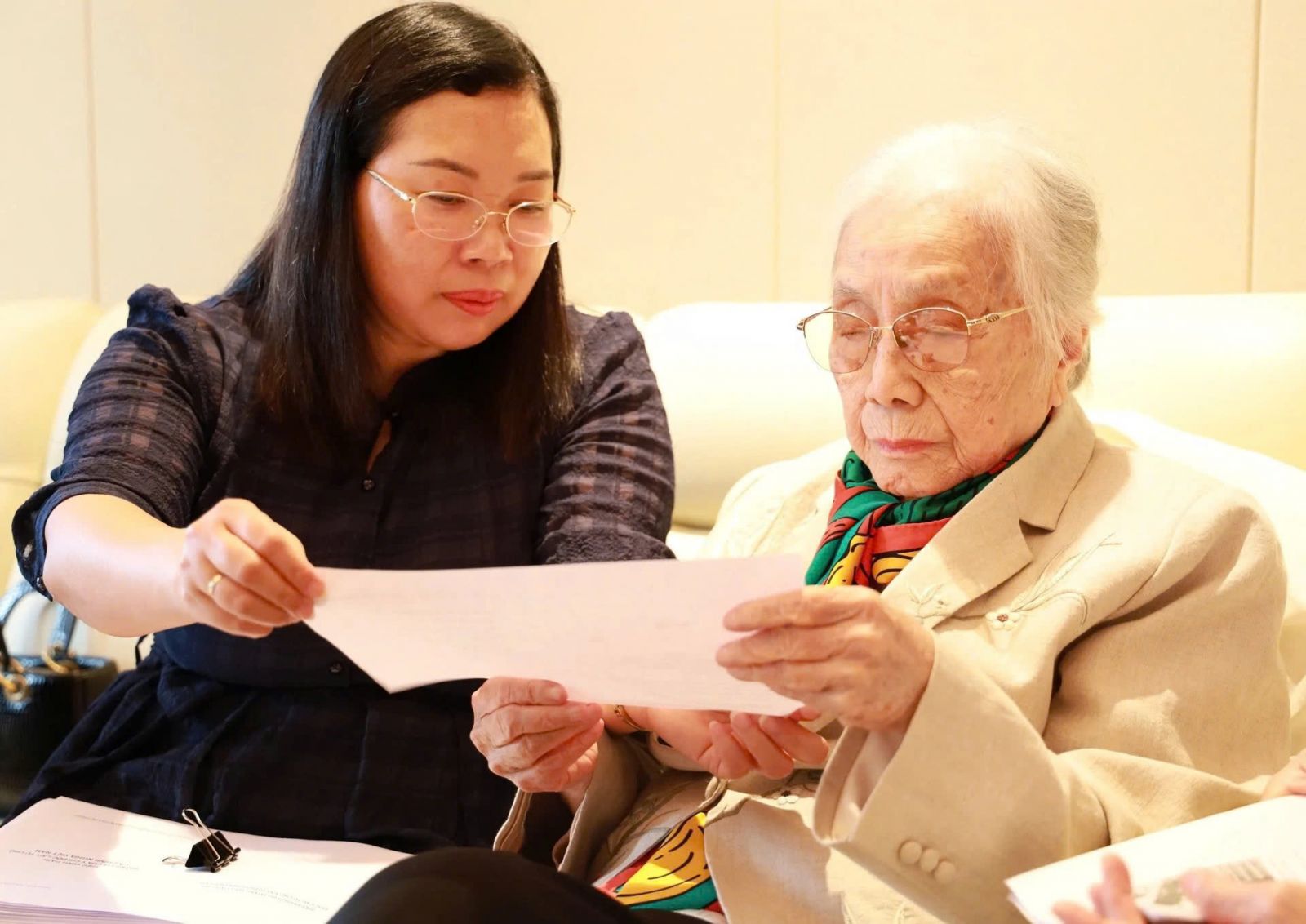
Comrade Pham Thi Thinh (left) discusses the book manuscript with former Vice President Nguyen Thi Binh. Photo: Provided by the interviewee.
When the book "Stories with Thanh" was recalled and destroyed, the publisher acknowledged shortcomings in its editing work. Improving the quality of book editing is a major concern for the publishing industry.
To publish a concise book with outstanding intellectual and artistic value, the book editor is someone who "walks the line": between openness and caution towards the author's new perspectives, between theory and practice, between frank criticism and gentle persuasion...
Editing is a job that contributes to creating intellectual value for society. Ms. Pham Thi Thinh, Deputy Director - Deputy Editor-in-Chief of the National Political Publishing House, shares her insights on the editing profession and the meticulousness of this process.
The editing process is rigorous and must be strictly adhered to.
- What is the current process for evaluating, editing, and controlling the output of manuscripts at the National Political Publishing House to ensure the quality of book content?
- Since its establishment, the Truth Publishing House (now the National Political Publishing House Truth) has always prioritized the quality of its publications. This is the key factor that has built the brand of the National Political Publishing House Truth for over 80 years.
To maintain its brand and the quality of its book content, the publishing house has established a rigorous publishing process, involving many steps and stages, and all staff and editors are required to strictly adhere to it.
The process can be summarized as follows: Upon receiving a manuscript from the author, the editorial board leader must conduct a preliminary review. If the manuscript meets the requirements, it is included in the publication plan. If the manuscript does not meet the requirements, it is returned to the author and not published. If the manuscript needs revision or additions, discussions are held with the author to finalize the revisions before returning it to the publisher.
Book editing is a specialized profession; only through self-learning can editors quickly mature and gain enough experience to minimize setbacks in their work.
Each manuscript must be read by the editor at least three times. After editing, it must be sent to the author for review, and discussions should be held with the author regarding necessary revisions to finalize the manuscript. All factual information in the manuscript, including any quotations from the author, must be cross-checked by the editor to ensure accuracy.
After the editor has finalized the manuscript, they write a manuscript review form with a full report on the manuscript's status and the editor's revisions, and then submit the manuscript to the editorial board leader for approval.
The editorial board leader reads, continues to edit, and provides feedback on the manuscript. If the manuscript requires significant additions or revisions, it is returned to the editor and author for further revision.
Once the manuscript is finalized, further comments are added to the manuscript review form and forwarded to the publisher for approval. The manuscript is then sent to the proofreading department for content and format review. If further corrections are found, it is returned to the editorial board and the author for further revisions.
After the manuscript is finalized, the proofreading department continues to write comments on the manuscript and submits it to the Deputy Director - Deputy Editor-in-Chief for review, who is responsible for the content. The publishing house's leadership continues to read and revise, and if necessary, they make additions or corrections directly on the manuscript or return it to the editorial board to work with the author on revisions.
After the report is revised, the Deputy Director - Deputy Editor-in-Chief reviews it, writes a manuscript review form, recommends that the editorial board sign a copyright agreement with the author, and grants permission for publication. Only after completing all the steps and procedures is it submitted to the Director - Editor-in-Chief for approval and printing.
The Director - Editor-in-Chief continues to review and approve the manuscript for publication. If there are no issues, they sign off on printing immediately; if further revisions are needed, it is returned to the editorial board for correction. However, all such revisions are then sent back to the Deputy Director - Deputy Editor-in-Chief, the proofreading department, and the editorial board for review and feedback.
After the manuscript is approved for printing, it is sent to the typesetting department for proofreading. During this process, if any errors are found, the editorial board will make further corrections and report them to the Director - Editor-in-Chief.
Throughout the entire process, from editing and proofreading at various levels to finalizing the draft for printing, the author must constantly collaborate with the publisher to revise and supplement the manuscript as required.
When printing books, before finishing, the printing house must send a sample book to the editorial board for review. The editor reviews the sample book, and if they find no issues with the content or printing quality, they write a sample book review form and report it to the editorial board leader. The publishing house leader then signs the sample book review form.
If errors are discovered during the proofreading process, further corrections or reprinting will be carried out, and the book will be fully processed before final publication. After printing, the book will be submitted for copyright registration as per regulations, and only 10 days later will the publishing house's leadership sign the decision to officially release the book.
For manuscripts containing important, complex, or sensitive content, the publisher establishes an evaluation committee, inviting experts and scientists to assess and provide feedback to improve the quality of the manuscript.
Thanks to such a rigorous editing, proofreading, and review process across multiple stages, the publisher's books are constantly improving in quality, ensuring scientific accuracy and standard content, earning the trust and high regard of readers.

The National Political Publishing House displays and introduces books at the 14th National Congress of the Party. Photo: VNA.
Books are "legacy texts," and editors must not make mistakes.
- In your opinion, how can we improve the quality of book editing, especially in the context of today's information explosion?
- Book editing is a specialized profession; only through self-learning can editors quickly mature and gain enough experience to minimize setbacks in their work.
During his lifetime, General Secretary Nguyen Phu Trong emphasized: "Books are monuments for posterity," and like monuments, they must not be flawed. With books, if errors occur, even small ones, they are difficult to correct.
Therefore, to improve the quality of book editing, it is first necessary to enhance the role and responsibility of editors and those involved in the book editing and publishing process, and to improve the quality of the professional workforce.
Because the quality of manuscript editing depends greatly on the responsibility and competence of the editorial team. If editors, those who work in this profession, lack responsibility towards the manuscript, they will not spend enough time reading the manuscript carefully, reading it multiple times to identify problems, not double-checking events, information, and quotations in the manuscript, and will not know what shortcomings or missing content the manuscript contains.
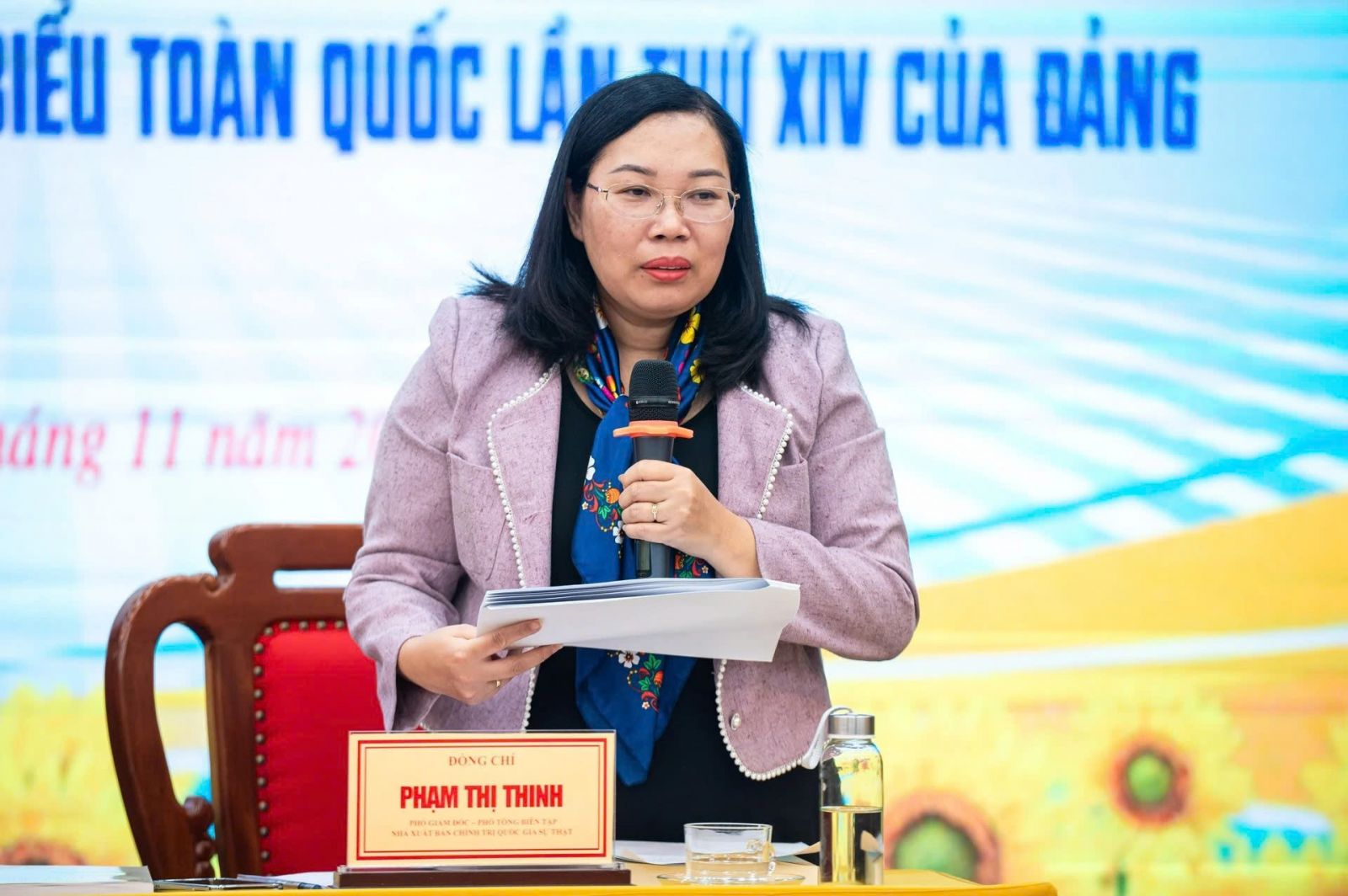
Comrade Pham Thi Thinh, Deputy Director - Deputy Editor-in-Chief of the National Political Publishing House. Photo: Dinh Ha.
If editors, those working in the profession, lack competence, fail to diligently study and improve their skills, do not cultivate additional knowledge and experience, and do not uphold professional ethics, then they will not have enough knowledge to detect errors, correct and improve the quality of manuscripts, provide feedback to authors on content, and especially, fail to identify politically sensitive issues in manuscripts to remove or modify them appropriately.
When every editor considers book quality as a professional honor, the quality of editing will be sustainably improved.
Therefore, every editor and professional must constantly improve their knowledge and experience, maintain political integrity, regularly study the Party's new resolutions, directives, and conclusions, firmly grasp Marxism-Leninism and Ho Chi Minh Thought, constantly update themselves on new theoretical and practical issues of the country, and enhance their ability to identify erroneous and distorted viewpoints in order to promptly detect and handle them during the editing process.
Only with a solid political foundation can editors accurately assess and process manuscript content. Editors need to cultivate in-depth editing skills for each type of book, becoming experts in a particular field, so that they can not only correct wording but also provide critical feedback to enhance the scientific value of the manuscript.
Furthermore, editors need to cultivate a meticulous and scientific work ethic, prioritizing the quality of published works. They must thoroughly read and understand the material before editing, and regularly learn from past mistakes to prevent future errors. Each editor must consider book quality as a matter of professional honor and the reputation of the publishing house. When each editor considers book quality as a matter of professional honor, the quality of editing will be sustainably improved.
The publishing house also needs to clearly define the responsibilities of editors, editorial board leaders, and publishing house leaders at each stage; strictly implement a multi-round proofreading process; and strengthen internal review of important manuscripts.
In the current context of digital transformation, applying technology to support the review of technical errors, spelling mistakes, cross-referencing, and data retrieval is also an important solution to improve the efficiency and quality of editorial work.
What qualities and skills does a good editor need?
A good editor must possess all three qualities: political integrity, professional ethics, and professional competence.
Strong political qualities: Possessing a firm ideological stance and strong political character; thoroughly understanding the Party's guidelines and policies, and the State's laws and regulations; capable of identifying and addressing politically and ideologically inappropriate content in manuscripts; clearly aware of the social and political responsibilities of those working in publishing.
Publishing is about choosing words, not arranging them. Those who work in publishing must be knowledgeable and experienced.
Ethical professional conduct: Honesty, objectivity, and meticulousness in work; a high sense of responsibility for each publication; respect for authors, truth, and scientific value; and a conscious effort to maintain the reputation and brand of the publishing house.
Solid professional qualifications: Possess in-depth knowledge of the assigned field; mastery of editing and publishing techniques; ability to accurately detect and correct errors; logical thinking, analytical, synthesis, and critical thinking skills; proficiency in editing tools and electronic data management; ability to utilize digital resources for editorial work.
In short, a good editor is someone who is "politically sound, morally upright, professionally competent, perceptive to practical realities, and technologically proficient," always prioritizing book quality and social responsibility. These are also the fundamental criteria for building a team of editors that meets the development requirements of the publishing industry in the current digital age.
Books are the essence of humankind; they are a synthesis of knowledge; a treasure trove of human wisdom; the teacher of all teachers; and the written legacy left by everyone for generations to come. Therefore, publishing is a profession of selecting words, not of arranging them. Those working in publishing must possess knowledge and experience to succeed.
- How can socio-professional organizations contribute to improving the quality of editing?
- Professional social organizations like the Vietnam Publishers Association play a role in gathering, uniting, and representing the publishing industry nationwide. Therefore, the Association can contribute to improving the quality of publishing activities through organizing training, professional development, and updating knowledge for editors and publishers.
The association can also act as a bridge, organizing conferences, seminars, and forums for publishers to exchange experiences in organizing and utilizing manuscripts; improving the quality of manuscript editing, sharing best practices and effective methods, and promoting innovation in publishing. The association can also participate in policy reviews and proposals to improve the legal environment and address difficulties in publishing activities.
In the context of digital transformation, the Association can play a supportive role in helping publishers apply technology, develop e-publishing, and enhance their competitiveness. Through awards, book fairs, and professional recognition activities, the Association contributes to encouraging creativity, responsibility, and professional ethics among those working in the publishing industry. In doing so, the Association becomes a crucial factor in promoting the professional, modern, and sustainable development of Vietnam's publishing industry.
Thank you for sharing your thoughts!
According to the online magazine Tri Thuc (Knowledge).
See the original article on Tri Thuc online magazine: https://znews.vn/bien-tap-vien-phai-coi-chat-luong-sach-la-danh-du-nghe-nghiep-post1663348.html?

Comments