



The rapid development of artificial intelligence (AI) is opening up great opportunities for economic growth, enhancing national competitiveness, and transforming production methods, social governance, and human life. However, along with these benefits, AI also raises many new issues, most notably the phenomenon of "AI junk"—misinformation, noise, and fake content created by AI—and the negative consequences arising from the design, operation, and use of AI without proper control, ethical standards, and a suitable legal framework.
Identifying and controlling "AI junk" in the digital age.
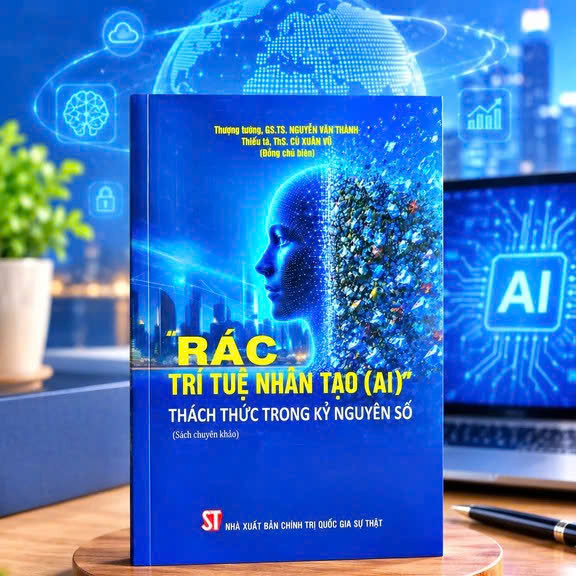
The book " Artificial Intelligence (AI) Junk - A Challenge in the Digital Age".
To provide readers with a more comprehensive and in-depth understanding of this issue, the National Political Publishing House publishes the book " Artificial Intelligence (AI) Garbage - A Challenge in the Digital Age , " co-edited by Lieutenant General, Professor, Doctor Nguyen Van Thanh and Major, Master of Science Cu Xuan Vu, with contributions from a team of authors including Lieutenant Colonel, Doctor Luc Anh Tuan, Lieutenant Colonel, Doctor Bui Thanh Tuan, and Major, Doctor Le Quang Viet.
Based on an interdisciplinary approach and updated international trends, the book focuses on clarifying the nature, characteristics, and manifestations of "AI junk"; and analyzes the multifaceted impacts of this phenomenon on the economy, society, national defense, security, foreign relations, and human life. Notably, "AI junk" is viewed not only in terms of the misleading content created by AI, but also in the entire process of forming and operating AI systems, from data junk, model junk, output junk to intentionally manipulating junk. This approach also points out the risk that misleading products created by AI will continue to become input data for other AI systems, thereby forming a loop of accumulating and amplifying errors.
The book consists of 3 chapters.
Chapter 1: Overview of Artificial Intelligence (AI) and "AI Junk ," focuses on clarifying fundamental issues regarding AI, its formation and development, the characteristics of "AI junk," and discusses the AI development strategies of several representative countries. This section also distinguishes "AI junk" from "fake news," clarifying the differences in nature, formation mechanisms, identification characteristics, spread speed, and processing methods between the two phenomena.
Chapter 2: “Artificial Intelligence Garbage” – A Multidimensional Challenge to National Development in the Digital Age , delves into the impacts of “AI garbage” on politics, lawmaking, and national governance; economics, culture, and society; defense, security, and foreign relations. The book points out that “AI garbage” can affect the trust of citizens, businesses, and the State, diminish transparency, hinder national governance, and raise issues concerning digital sovereignty. In the cultural sphere, “AI garbage” is also considered a risk to the erosion of national creativity, identity, and soft power; in foreign relations, this issue is linked to challenges concerning information, perception, prestige, and national interests in the digital space.
Based on identifying these challenges, Chapter 3: Policy Orientation, Control Solutions, and Guidance on Preventing "Artificial Intelligence (AI) Junk" in the Digital Age , focuses on new requirements for the nation in the AI era; perspectives and principles guiding policy control of "AI junk"; solutions to enhance control; and recommendations on prevention and identification processes for "AI junk".
Notably, the book outlines an 8-step process for preventing "AI junk," from understanding AI correctly, controlling input information, evaluating and verifying AI-generated results, using AI for the right purpose and role, being cautious when sharing, complying with laws, ethics, and culture, to detecting, reporting, and preventing the spread of "AI junk," and continuously improving digital knowledge and skills. Through this, the book emphasizes the central role of humans, in which humans must retain control and ultimate responsibility in the process of using AI.
From the perspective of technology governance, AI ethics, and human security, the book addresses the issue of controlling "AI junk" in relation to the need to improve institutions, enhance the effectiveness of state management, develop a healthy technology ecosystem, and raise awareness and the capacity of society to respond to AI products. At the same time, given the transnational nature of AI and "AI junk," the book emphasizes the need to strengthen international cooperation, proactively participate in building international standards and "rules of the game" for AI, and protect digital sovereignty, national security, and national interests in the digital age.
In the context of Vietnam's accelerated development of a digital government, digital economy, and digital society, identifying and effectively controlling "AI junk" has become a necessary requirement, linked to the goal of sustainable development and ensuring national interests. With an interdisciplinary and systematic approach, combining theoretical explanations and practical issues, " Artificial Intelligence (AI) Junk - Challenges in the Digital Age" contributes to providing additional resources for policymakers, managers, researchers, media outlets, and readers interested in AI and digital transformation; while simultaneously raising awareness, skills, and responsibility in the safe, effective, and responsible use of AI.

Comments