



TCCS - Our country is entering a new era amidst a rapidly changing, complex, and unpredictable world. Strategic competition is becoming increasingly comprehensive across geopolitical, geo-economic, technological, data, financial, supply chain, energy, and cyberspace spaces. Traditional and non-traditional challenges are intertwined, impacting the economy, society, national defense, and national security... This reality demands a strong shift from management to modern national governance; from decentralized management to unified governance; from passive response to proactive forecasting, prevention, enhancing resilience, and fostering development, with the relationship between security and development at its core.
The Party's new theoretical thinking on modern national development governance: An approach from the perspective of the relationship between security and development.


General Secretary and President To Lam attends the 2026 National Day for Protecting National Security in Long Luong village, Van Ho commune, Son La province, on July 15, 2026. (Photo: VNA)
Security is not only a condition for protecting achievements, but is increasingly becoming an inherent attribute and capability of development itself. At the same time, development not only creates resources for national defense and security, but also builds the foundation for institutions, technology, culture, society, human resources, self-reliance, and the overall strength of the nation.
1. Innovating thinking about modern national development models and development governance.
Over the past 40 years of implementing reforms, the Party's theoretical thinking on national development and governance has been continuously supplemented and perfected. The understanding of development has expanded in the direction of linking growth with progress, social equity, cultural and human development, and environmental protection; linking national development with strengthening national defense, ensuring security, and enhancing the effectiveness of foreign relations and promoting international integration.
Development today is not simply about increasing the size of the economy, raising incomes, or expanding production capacity, but rather a process of building a comprehensive system of institutional, economic, social, cultural, human, scientific, technological, defense, security, and foreign policy capabilities; with a focus on improving the quality of life, ensuring conditions for the comprehensive development of human beings, the happiness of the people, and consolidating and enhancing the nation's position.
Entering a new era, the development model heavily reliant on capital, resources, cheap labor, and increasing inputs has revealed its limitations. Development advantages are increasingly determined by the quality of institutions, scientific and technological capabilities, innovation, data, the quality of human resources, governance capacity, the degree of national autonomy, and resilience. Reforming the development model must be a synchronized transformation, encompassing economic growth models, national governance models, cultural and social development models, human resources, defense, security, foreign relations, and, more profoundly, towards successfully implementing the Vietnamese socialist model.
The renewal of Vietnam's development model, in essence, has been affirmed by our Party as a process of transformation from a traditional development model to a modern, inclusive, humane, and sustainable development model, with people at the center; science, technology, and innovation as the main driving force; culture as the foundation; and modern national development governance as the method of organizing and leading development. Accordingly, we inevitably need a new governance method. State management remains an irreplaceable function, but modern national development governance has a broader scope, with many entities participating, overcoming the rigidity of administrative management and the separate operation of each sector and field. This is the method of "Party leadership, State creation, people's ownership" (1) ; responsible participation of the market, enterprises, social organizations, communities, and people; capacity to create institutions, coordinate interests, mobilize, allocate, and control resources; The ability to translate strategic guidelines and objectives into practical actions and results.
Shifting from a managerial mindset to a governance mindset does not diminish the role of the State; rather, it strengthens discipline, order, harmony, and security. Furthermore, it is a process of elevating the State's role from directly handling affairs to creating laws and institutions, building an environment for innovation, developing system governance capacity, leading major transformations, and addressing inter-sectoral, inter-regional, and inter-level issues.
Modern governance must shift from a focus primarily on processes to one that prioritizes results, products, and real-time performance; from fragmented information to interconnected data sharing; from situational coordination to interconnected, institutionalized systems; and from administrative responses to governance based on forecasts, evidence, scenarios, and risk assessment. The core principle is not only to make each agency and sector more efficient, but also to organize the unified operation of the entire national development system. More importantly, in the current context, given the new demands for modern national governance, it is necessary to thoroughly understand the Party's viewpoint on closely combining the two strategic tasks: national construction and national defense. In accordance with the spirit of Resolution No. 44-NQ/TW, dated November 24, 2023, of the 8th Plenum of the 13th Central Committee, "On the Strategy for National Defense in the New Situation," it is necessary to closely combine socio-economic development with strengthening national defense, ensuring security, and expanding foreign relations. This is a consistent requirement throughout all stages of the Vietnamese revolution.
Previously, national defense and security were primarily viewed as conditions for ensuring a peaceful and stable environment and protecting development achievements. That approach remains entirely correct, but it is insufficient in the new context. When new development drivers simultaneously create new forms of dependence and vulnerability, security must be integrated into the development structure from the outset. Every strategy, plan, policy, infrastructure project, digital transformation plan, green transformation plan, or international integration plan needs to be considered in terms of both its ability to create development drivers and its ability to strengthen the nation's self-reliance, safety, adaptability, and resilience. We cannot wait until a project is completed, the system is operational, or an incident occurs before adding security requirements. Security must truly become a criterion for the quality of policy decisions and a component in the design of the development model.
Security is the foundation and environment for development. Without peace, political and social stability, order, discipline, legal security, social trust, and policy predictability, it is impossible to effectively mobilize and utilize resources in the long term. A solid security environment reduces risk costs, strengthens the confidence of citizens, businesses, and investors, and protects the flow of capital, goods, people, data, knowledge, and technology.
Security is both an attribute and a standard of development. A rapidly growing economy that is overly dependent on a single market, technology source, transportation route, or energy source cannot be considered sustainable. A rapid digitalization process, but without the protection of national data and critical digital infrastructure, can put development achievements at significant risk. The level of security, safety, autonomy, adaptability, and resilience must become criteria for evaluating the quality of development.
Conversely, development is both the foundation and the means to strengthen security. Economic development creates resources and infrastructure; science and technology create strategic self-reliance; cultural, educational, and human development create sustainable endogenous momentum; social progress and equity build trust, strengthen unity, and mitigate the root causes of instability; and transparent and effective institutions contribute to increased consensus and enhanced social responsibility. A nation's security cannot be sustainable if it is characterized by stagnant development, inequality, dependence, vulnerability, and a lack of strategic trust.
Comprehensive, modern, sustainable, and inclusive development is the fundamental approach to addressing security risks at their root. When people have stable jobs and livelihoods, equitable access to education, healthcare, public services, and development opportunities; when communities are able to protect themselves, adapt, and recover from shocks; and when society maintains trust, discipline, and consensus, then the foundation of national security is firmly consolidated.
Security and development are intertwined, but asymmetry can also arise. This necessitates sound and proper governance. Absolute focus on short-term development goals can lead to neglecting environmental, social, technological, and sovereignty risks, while "security-izing" every issue and applying excessive control measures can stifle innovation, narrow the space for change, increase compliance costs, and miss opportunities for development. Modern governance must identify long-term interests, classify risks, determine acceptable thresholds, and design appropriate control mechanisms. Security is a prerequisite and a crucial driving force for faster, more targeted, and sustainable development.
Therefore, the Party's new theoretical thinking today not only emphasizes the continued "combination" of security with development as two parallel fields, but also integrates security and development goals into a unified governance system, from strategic planning, institution building, resource allocation to implementation, monitoring, and evaluation of results.
2. Building a security structure in modern national development governance.
Today's threats are not isolated, confined to administrative borders or the scope of a single industry or sector, but are interconnected, transnational, and can accumulate silently or erupt rapidly, causing chain reactions. Therefore, a linear, single-sector security mindset, primarily focused on dealing with consequences, no longer adequately meets the requirements of protecting national interests. In this context, a new security thinking framework is needed, encompassing comprehensive security, overarching security, proactive security, and development-oriented security. These are not separate concepts, but rather aspects of a unified logic of national security in modern development governance.
Firstly, comprehensive security reflects an expansion in the scope, subjects, and space of protection. Besides protecting political security and firmly safeguarding sovereignty, social order, and safety, issues of economic, financial, energy, food, water, health, environmental, cultural, human, scientific and technological, data, cyberspace, supply chain, and critical infrastructure security are increasingly emerging. Emphasizing the "comprehensive" nature means adding security areas, and more profoundly, recognizing the systemic nature and the increasingly complex interplay and transformation of various risks and development challenges. The comprehensive nature also reflects the methods of organizing and leveraging strength; requiring a clear identification of what needs to be protected, how to protect it, and with what strength. This involves the synchronized combination of political, legal, economic, cultural, social, scientific and technological, defense, security, and foreign policy tools. Inter-sectoral, inter-level, and inter-regional coordination; the connection between the central and local governments, between specialized forces and development entities, and between the capacity of the State and the resources of businesses, communities, and the people. Ensuring comprehensive security does not mean dividing responsibility equally or everyone doing the same thing, but requires clear delineation of authority, focal points, data sharing mechanisms, coordination processes, accountability, and unified governance and command capabilities when complex situations arise. It is a synthesis of potential, forces, strategies, tools, resources, information, and methods of action.
Secondly, inclusive security reflects the goals, values, and beneficiaries of security. The concept of inclusive security emphasizes that people are both the center of development and the ultimate subject and goal of security assurance. National security is only truly solid when the security of individuals, communities, businesses, and localities is guaranteed; when no social group, region, or sector is outside the vision of security and development. A society where many people are left behind, areas with difficult socio-economic conditions lack development opportunities, and vulnerable groups are not protected from the risks of transition will accumulate long-term instability. Therefore, inclusive security must be linked to social welfare, safety, people's well-being, equal opportunities, fairness in access to public services, protection of vulnerable groups, strengthening trust, and enhancing the resilience of communities. Protecting the Fatherland first and foremost means protecting the peaceful lives, comprehensive development opportunities, dignity, legitimate interests, and happiness of the people. When people participate, are protected, and fairly enjoy the fruits of development, each individual and each community will become an active entity in national security.
Thirdly, proactive security must become a consistent mindset and fundamental method of action in protecting national security. The core of proactive security is maintaining strategic autonomy; improving the ability to forecast and identify early risks and new forms of security breaches; not allowing the country to become dependent or fall into a passive position in the face of complex and unpredictable changes. Proactively build a solid people's defense posture and people's security posture from the central to the grassroots level; fully prepare potential, organize a lean, strong force, ready to effectively handle all situations. At the same time, we must master technology, techniques, data, essential infrastructure, ensuring political and social stability and sustainable economic growth. "Security protection must be implemented early, from afar, right in each strategy, plan, and project" (2) and in all development spaces; resolutely not allow strategic losses to occur to the country.
Fourth, developmental security represents a crucial shift in thinking about the function of national security. Security is not limited to preventing and addressing threats to stability, but must proactively create a peaceful, stable, safe, and predictable environment for development. Accordingly, ensuring security must be linked to unlocking resources, protecting the investment environment, maintaining the smooth operation of markets, technology, data, and supply chains; and simultaneously strengthening the confidence of citizens, businesses, investors, and international partners. In the economic, technological, and innovation sectors, developmental security requires diversifying markets, partners, and supply sources; enhancing endogenous capacity, resilience, and adaptability to shocks; contributing to gradually mastering core technologies, strategic infrastructure, and critical data; developing high-quality human resources; and proactively controlling the risks of dependence, disruption, or domination. However, autonomy does not mean isolation; it must be linked to proactive international integration, expanding cooperation, and accessing advanced knowledge, technology, and resources. Security, therefore, becomes a constructive capacity, both protecting achievements and paving the way, creating momentum for rapid and sustainable development.
The four aforementioned security elements form a unified whole: comprehensive in scope, modern in quality, integrated in methods, inclusive in objectives and targets, constructive in function; proactive in strategic forecasting; forming a structure of comprehensive national security, protecting the Fatherland, protecting the people, protecting the regime, creating a favorable environment for development; linking security governance with development governance in the current period.
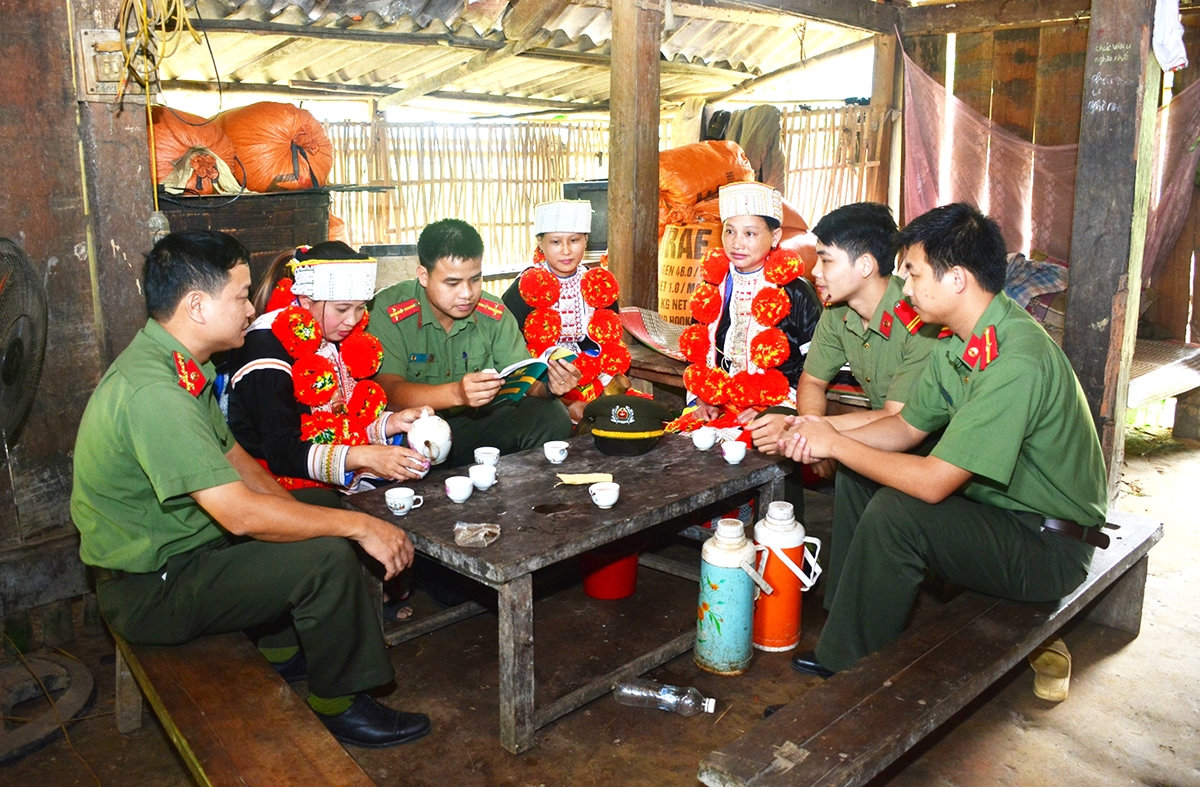

Police officers in Lam Binh commune, Tuyen Quang province, disseminate legal information and mobilize the public in the residential area. (Photo: dantocphattrien.vietnamnet.vn)
3. Some integrated solutions in modern national development governance.
To translate new theoretical thinking on the relationship between security and development into practical national governance, it is necessary to focus on implementing the following major solutions:
First, we need to refine our theoretical thinking on national development management and security.
The development of theoretical thinking on modern national development governance necessitates continued innovation in national governance methods. When development and security are integrated into a single entity, all development decisions must simultaneously aim to create growth momentum, enhance national self-reliance, adaptability, and resilience; at the same time, defense, security, and foreign policy must truly be a component contributing to protecting and expanding development space, strengthening confidence, attracting resources, and enhancing the country's standing. Accordingly, modern national development governance is not only about managing the development process, but also about creating and leading development.
It is necessary to clarify the content, the implementers, principles, tools, and requirements of development governance; to distinguish, but not separate, leadership, management, and governance; and to establish the relationship between development goals and security requirements in each strategy, plan, and development policy. Integrating security with development issues should not be done mechanically, narrowing the development space, but rather should become a method for evaluating the quality, sustainability, and resilience of policy decisions. Each development policy needs to be comprehensively considered in terms of economic efficiency, social and environmental impacts, self-reliance, and potential security risks. Based on this, a national interdisciplinary research program should be developed, connecting key fields related to the relationship between security and development, such as political science, economics, law, sociology, technology, and security, to explain the unity between comprehensive security, inclusive security, and security that fosters development.
Secondly, enhance the capacity to forecast and strategically manage security challenges.
Modern governance cannot rely solely on past experience; it must possess the ability to identify and predict new trends, potential risks, and even low-probability but high-impact challenges. Forecasting capabilities must become a permanent component of leadership, policy planning, and implementation processes.
It is necessary to build a system for analyzing and forecasting strategic risks, a mechanism for information sharing, methods for developing scenarios, testing policies, and assessing the resilience of each sector, locality, and critical infrastructure. A proactive, early prevention mindset must be concretized with data, indicator systems, decision-making processes, and clear accountability.
Interdisciplinary challenges cannot be effectively addressed by isolated administrative mechanisms and processes. It is necessary to clearly define focal points, coordinating authorities, data sharing mechanisms, resource mobilization mechanisms, and accountability for issues related to economic security, energy, health, environment, cybersecurity, data, and supply chains.
Decentralization and delegation of authority in addressing security and development challenges must go hand in hand with specific empowerment, resource allocation, enhanced enforcement capacity, inspection, supervision, and ensuring unified command when necessary. The situation where a problem falls under the responsibility of multiple agencies but none take full responsibility must be overcome.
Establishing standards for data collection, management, sharing, exploitation, and protection. Developing digital infrastructure, shared databases, and data-driven decision-making systems must be linked to ensuring cybersecurity, protecting privacy, national digital sovereignty in cyberspace, and technological self-reliance. Narrowing the digital divide and improving the digital skills of officials and citizens is crucial to prevent the digitalization process from increasing inequality, creating new exclusionary groups, or putting groups at high risk of cybersecurity and data security breaches. Digital governance is only truly modern when it simultaneously enhances the efficiency of state operations, expands development opportunities, and ensures the rights of the people.
Third, innovate the development model while ensuring security and strengthening strategic autonomy.
Self-reliance does not mean isolation, separation, or detachment, but rather the ability to choose, replace, and adapt, without being passive in the face of external pressure. It requires developing science and technology, innovation, foundational industries, strategic infrastructure, and high-quality human resources; diversifying markets, partners, capital sources, and supply sources; and enhancing Vietnam's position in global value chains and production chains.
Each step of integration must “both expand development opportunities and strengthen strategic autonomy, strategic connectivity and protect national interests” (3) . It is necessary to shift from a passive, dependent response mindset to a proactive strategic approach and management of interdependent relationships, effectively exploiting the positive aspects of international integration, but without creating bottlenecks or disruptions that could weaken the national policy-making capacity.
This development in theoretical thinking provides a foundation for further refining the Party's theoretical system while proactively adapting to the major transformations of the era. Digital transformation, green transformation, energy transformation, innovation, artificial intelligence, data, cybersecurity, economic security, supply chain security, and non-traditional security challenges are no longer isolated issues of individual sectors or fields, but need to be studied and addressed within the overall framework of a modern national development model and a unified governance approach.
Fourth, create a solid social foundation for development, ensuring safety, adaptability, and resilience.
It is necessary to strengthen a flexible social security system, improve the quality of public services, protect vulnerable groups, develop sustainable livelihoods, and focus on disadvantaged areas, strategic locations, and regions heavily impacted by climate change, energy transition, and automation.
Social trust, a culture of responsibility, respect for the rule of law, and community strength must be considered crucial resources for national security. A united society with trust, self-organization, and mutual support will be more resilient to shocks and will create a solid social foundation for development.
Resilience requirements must be implemented at the grassroots level, where people directly face natural disasters, epidemics, job losses, cybercrime, and life-changing shocks. Each locality needs to create and disseminate risk maps to the community level, organize appropriate drills, and develop a warning network and on-site support forces capable of responding promptly when the central system is disrupted. Mechanisms such as insurance, emergency credit, vocational retraining support, and livelihood recovery are necessary to prevent people from falling into a cycle of poverty after a crisis. Simultaneously, attention must be paid to mental health, access to reliable information, and the ability to recognize misinformation. Through this, people become both beneficiaries of protection and active participants in risk prevention, contributing to improved response capacity and societal recovery.
Rethinking the model of national development and development governance is an objective requirement and a decisive factor in realizing the aspiration of building a strong, prosperous, civilized, and happy nation. Accordingly, it is necessary to shift from viewing security primarily as a condition for protection to defining security as an intrinsic component of development; from responding to risks to proactively forecasting, preventing, adapting, and enhancing resilience. Modern national development governance must closely link security with development, build institutions, mobilize resources, and leverage the combined strength of the entire political system, the entire population, and the entire society. Security creates the environment and confidence for development; development strengthens the potential and sustainable foundation for security, thereby protecting national interests, maintaining independence and self-reliance, and firmly defending the socialist Fatherland of Vietnam.
--------------
(1) Documents of the 13th National Congress of Delegates, National Political Publishing House, Hanoi, 2021, Vol. I, p. 284
(2) Documents of the 13th National Congress of Delegates, Ibid., Vol. I, p. 156
Source: Communist Magazine - https://www.tapchicongsan.org.vn/web/guest/media-story/-/asset_publisher/V8hhp4dK31Gf/content/tu-duy-ly-luan-moi-cua-dang-ve-quan-tri-phat-trien-quoc-gia-hien-dai-tiep-can-tu-moi-quan-he-giua-an-ninh-va-phat-trien

Comments